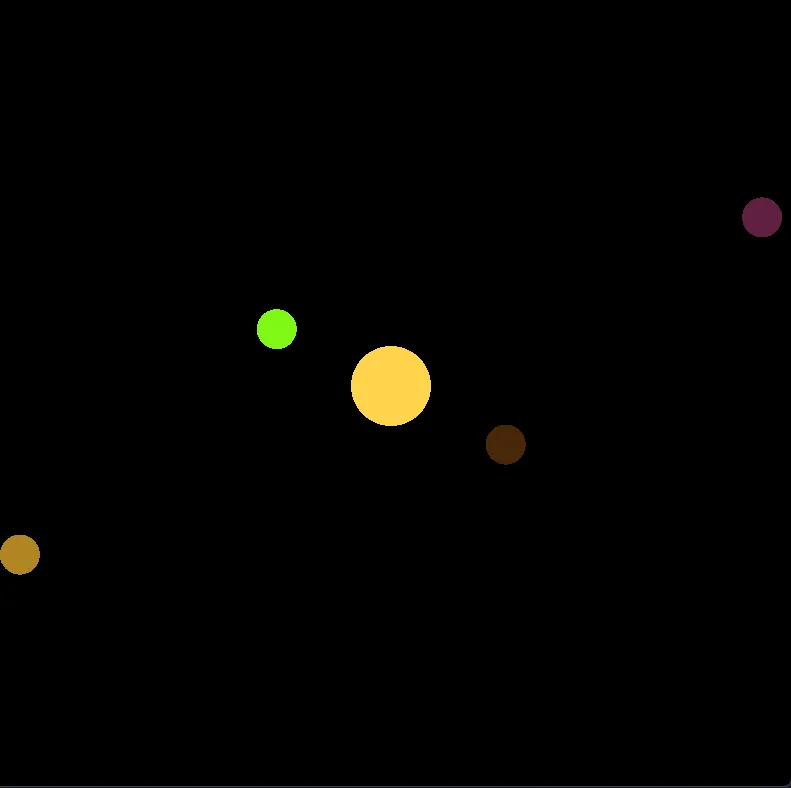
2D Gravity Simulation from Scratch
I have always been interested in how humans came to be. Was it the big bang? Is there some sort of God? Are we in a simulation? All impossible questions (for now). The goal of these projects is to better myself at taking real life things and putting them inside a computer. To make strides towards one day putting consciousness inside the computer.
Anyway… back on track. This project is a 2D particle simulation built from scratch in C++. I have built a few things and most of them are in something higher level. I took away all of that for this project. If you would like to take a look at the code, here is the link.
I learned a lot on this project: shaders, OpenGL, and good object-oriented programming. However, I think the most interesting part (the fun part for me) is the physics equations.
Rather than relying on a prebuilt physics engine, I coded the physics myself.
Calculating Particle Mass
Before we can start making gravitational forces, we need to make each particle have some sort of mass. In the real world, I would multiply density by volume. However, this isn’t the most realistic simulation… It is 2D!
To find the mass, I am going to use the area of the circle instead.
The area of a circle, as most of us (probably) know, is:
Multiplying this by density, we get:
Where:
- m = particle mass
- () = particle density
- (r) = particle radius
In the code, I calculate a particle’s mass in the constructor:
float mass = density * 3.14159 * radius * radius;This is a 2D model, so it is simplified compared to spheres or more complex objects (something I will definitely be getting into in the near future).
It is simple, yet it is good at giving my particles some mass. This is going to be important when we start talking about gravity (which is right now).
Gravity
The main equation that I use is based on Newton’s law of universal gravitation.
Where:
- = magnitude of the gravitational force
- = gravitational constant
- = masses of the particles
- = distance between their centers
There are two interesting properties that you probably know about:
- Since masses are in the numerator, gravity increases as objects gain mass.
- Since the distance between the centers is in the denominator, gravitational pull decreases the further away you are.
If you were standing next to the sun, you would feel an immense pull towards it. If you were on the edge of our galaxy, you wouldn’t feel it at all.
Gravity needs a direction
The equation above is nice for finding how strong the pull is (the magnitude of the vector), but we also want to know which direction to accelerate. Intuitively it is obvious, but we have to turn this into code.
To calculate a vector pointing from particle A to B:
To convert this into a unit direction vector, I divide by its magnitude:
The gravitational force is then written as:
Or
This is because . The magnitude of the vector is the distance between the two particles.
Implementation of the Gravity
const Vec2 direction = b.pos - a.pos;

const float distSq = direction.lengthSquared() + SOFTENING * SOFTENING;

const float invDist = 1.0f / std::sqrt(distSq);

const float forceMagnitude = G * a.mass * b.mass * invDist * invDist * invDist;

const Vec2 force = direction * forceMagnitude;

a.applyForce(force);
b.applyForce(-force);
The softening is to prevent gravity from becoming excessively large when particles are extremely close together.
But doesn’t it all make sense after following the steps before?
In my code I used a gravitational constant of 0.6f, rather than the real world value of ~, because my simulation isn’t very realistic (at least this one, hint… hint…).
Newton’s Second Law: From Force to Acceleration
Now that I have the force, I need to determine how it changes the particle’s motion.
Newton’s second law is:
If we rearrange this equation, we can get:
This tells me that acceleration is the force divided by a particle’s mass (so a particle that has less mass will be more affected by a force).
In my code, I do:
void Particle::applyForce(const Vec2& force) {
    Vec2 acceleration = force / mass;
    v += acceleration * FIXED_DT;
}
Notice that I do not change position, instead I change the particle’s velocity (v is velocity in the code).
This comes from the relationship:
Since computers simulate time in discrete steps, I approximated the velocity change by using:
Where is the length of one physics timestep.
Detecting Particle Collisions
This is where things got… interesting. Before this I had no idea how to calculate collisions. I first thought about two objects going straight at each other: well, you just reverse their velocities, easy. How about if they hit at an angle?
Before we answer that question, how do we know two particles are colliding? Well, we know when the distance between their centers is less than or equal to the sum of their radii.
Mathematically:
My implementation looked like this:
bool Particle::isColliding(
    const Particle& otherParticle
) const {
    const Vec2 diff = pos - otherParticle.pos;
    const float rDist =
        radius + otherParticle.radius;

    return diff.lengthSquared() <= rDist * rDist;
}
Resolving Collisions using Impulse
Detecting the collisions is pretty simple; solving them, well… that needs some more work.
Instead of manually reversing their velocities, I used impulse-based collision resolution.
What does that mean? An impulse represents a change in momentum. It is caused by a force acting over a period of time (in this case, the particles colliding).
In equation form:
Since momentum is mass multiplied by velocity:
The collision must account for the masses and relative velocities of both particles. The scalar impulse equation I use is:
Where:
- (j) = impulse magnitude
- (e) = coefficient of restitution
- () = particle velocities
- () = collision normal
- () = particle masses
The coefficient of restitution determines how much relative speed along the collision normal is retained after impact.
An (e) value of 1 represents a perfectly elastic collision (which is what I used), while 0 represents a perfectly inelastic normal response.
After calculating the impulse, I updated their velocities:
In the code:
const float impulse =
    -(1.0f + e) * velocityAlongNormal
    / (invMassA + invMassB);

const Vec2 impulseVec = normal * impulse;

a.v -= impulseVec * invMassA;
b.v += impulseVec * invMassB;
I also correct overlapping particle positions using their inverse masses, so that particles do not remain stuck inside one another (a fun little bug).
In the current simulation, the central sun behaves differently: particles that collide with it are removed instead of bouncing away.
Putting it Together
With the equations that we talked about, we now have a main repeating process:
- Calculate gravitational forces between particle pairs (do this for every pair).
- Convert those forces into acceleration.
- Update each particle’s velocity.
- Update each particle’s position.
- Detect and resolve collisions.
- Render the new particle positions.
This project is so interesting because when you have many particles, there are so many forces pulling each particle in different ways.
The result is a simulation where particles can accelerate towards each other, collide, and orbit/curve around massive objects.
Final Thoughts
This project taught me a lot of things about physics, programming, and math. This taught me in a way that was better than watching a video or reading about it.
There are plenty of improvements I could make: better collision handling, 3D, making simulated orbital paths. But I think this is a good starting project for physics.
I think this is why simulating things is so interesting to me: you put a few simple equations together and you come out with something beautiful.
Discussion
Loading discussion…